The Greatest Breakthrough Since Lunchtime #19

For the history of TGBSL series take a look here.

Beer leftover hops could help fight dental diseases.

From Business Standard – link to full article here.

Researchers have reported that the part of hops that isn’t used for making beer contains healthful antioxidants and could be used to battle cavities and gum disease.

In the new study, the researchers have claimed to have identified some of the substances that could be responsible for these healthful effects.

Yoshihisa Tanaka and colleagues note that their earlier research found that antioxidant polyphenols, contained in the hop leaves (called bracts) could help fight cavities and gum disease.

Extracts from bracts stopped the bacteria responsible for these dental conditions from being able to stick to surfaces and prevented the release of some bacterial toxins.

Every year, farmers harvest about 2,300 tons of hops in the United States, but the bracts are not used for making beer and are discarded. Thus, there is potentially a large amount of bracts that could be repurposed for dental applications.

But very few of the potentially hundreds of compounds in the bracts have been reported. Tanaka’s group decided to investigate what substances in these leaves might cause those healthful effects.

Using a laboratory technique called chromatography, they found three new compounds, one already-known compound that was identified for the first time in plants and 20 already-known compounds that were found for the first time in hops.

The bracts also contained substantial amounts of proanthocyanidins, which are healthful antioxidants.

The new study has been published in the ACS’ Journal of Agricultural and Food Chemistry.

The Dentistry Show

I realise that it has come and gone by just over a week but I thought I would keep my powder dry on my thoughts on the Dentistry Show for a while.

Having made the gradual transition from delegate to provider (if that word hasn’t been devalued by the 2006 NHS contract) I see things from a different perspective. So my visit is for two days and I talk to people on stands for different reasons.

The general impression was that the show has definitely come of age and compares well with both Dental Showcase and the BDA Conference. It is different from each of these but they could both learn a good deal from the Show. The BDA conference reflects the Association itself, poorly led, not sure exactly where it’s going or what its membership really wants. The Dentistry Show by comparison feels younger, more vibrant and more in touch with what the majority of dentists are doing or at least trying to do in their practices every day.

One huge improvement was the lecture theatres, far more professionally arranged – well done. My concerns are still that business calls the shots, so many of the speakers were sponsored by certain companies and therefore tended to speak favourably about their sponsors. You may say it’s the way of the world, but I wouldn’t be comfortable if at a medical conference a speaker was bigging up an antibiotic because they were being paid to do so.

On the technology front I was fascinated to see the revolution that digital impressions and 3-D printers are bringing to dental laboratories and their products.

It’s hard to remember the world without STO (Short Term Orthodontics). I encourage my clients to cautiously embrace the benefits that these can bring for their patients. I also have to remind myself that just because someone has thrown millions of $/£/€ at marketing doesn’t mean that osteoclasts and osteoblasts have changed their behaviour and that relapse, occlusion and perio are still big factors leading to disappointed patients.

One of the highlights was sitting and palying with the products from Welltime. I was particularly impressed with Patient Connections a system providing the ability to automate your patient feedback system. Easy Dental Referrals is an elegant way for dentists who take referrals to help their referring dentists and to keep them informed of treatment plans and progress. Finally, I loved their TrueNorth Dental Dashboard system which helps practices to monitor the performance of their businesses; this is currently being beta-tested, watch this space.

It seems that the divisions in dentistry are continuing to grow. On the one hand there are those who are very optimistic about their future. They are the ones who continue to embrace change by incorporating different skill sets into their practices by delegating as much as they can. They take their dental businesses seriously, learning from the best within dentistry and observing what makes for excellence in other spheres. They invest in themselves and their teams, many bringing team members to the NEC for the experience and two days of CPD.

On the other are those who seem to believe that in spite of many disappointments over the years the next new NHS contract, in no matter which part of the UK they reside, will bring them hope. They know there’s going to be no more money, no change in control and no more freedom to practice the dentistry to which they should aspire. Some were there only to tick CPD boxes and perhaps to be one of the ones have made the decision to jump, and the talk on the Plan Provider stands was of increasing numbers of NHS practice owners saying, “enough, how do I get out of this system?”.

One of the highlights for me was being able to take part in Practice Plan / The Business of Dentistry’s re-make of the Peter Kay, Children in Need video of Tony Christie’s hit “Show me the way to Amarillo”. This time led by Les Jones in the Peter Kay role we were fund raising for Bridge2Aid. With Jem Patel in autocratic director mode the participants did as much as they could to show their skills at walking and lip-synching around the aisles of the hall. Watch this space.

The other Bridge2Aid awareness raiser was “a sea of pink” where loads of companies had their own logos added to the charity’s distinctive pink shirts. Saturday will never be the same again.

I have only skimmed the surface of this I realise but The Dentistry Show has come a long way from Jonny Rees’s dream with one theatre and a dozen stands less than a decade ago. Well done & here’s to 2015.

banner_ds_2015_main_header_logo

The Monday Morning Quote #256

“The world is a dynamic mess of jiggling things, if you look at it right.”

Richard Feynman

Such a joy to watch

I do wish I had written that…#1 – Learning Outcomes (and the Golgafrinchans)

First in an occasional series. The surname of the writer may be familiar to you.

I was told off last week at a course that I had organised that as the “learning outcomes” were shown on neither the feedback form nor the attendance certificate then the Genera Dental Council might look unfavourably on the validity of the course content. My thoughts are that people who devise these rules, those who enforce the rules and particularly those who take any notice of them really belong in the Golgafrinchan middle classes. Look out, because the space goat will get you and no amount of learning outcomes will save you.

From the med.ed.ed blog 

Original here: http://mededed.me/2014/02/05/jorge-luis-borges-and-learning-outcomes/?utm_source=rss&utm_medium=rss&utm_campaign=jorge-luis-borges-and-learning-outcomes

Jorge Luis Borges and Learning outcomes

by reestheskin on February 5, 2014

Whenever I hear or read the phrase ‘learning outcomes’ I think of the story ‘On Exactitude in Science’ by Jorge Luis Borges. It is a short story, very short in fact, coming in at fewer than 150 words. So the danger in attempting to describe what it is about, is that you use more words than Borges himself. The hazards of summary or précis is of course part of its subject. So here it is:

…In that Empire, the Art of Cartography attained such Perfection that the map of a single Province occupied the entirety of a City, and the map of the Empire, the entirety of a Province. In time, those Unconscionable Maps no longer satisfied, and the Cartographers Guilds struck a Map of the Empire whose size was that of the Empire, and which coincided point for point with it. The following Generations, who were not so fond of the Study of Cartography as their Forebears had been, saw that that vast Map was Useless, and not without some Pitilessness was it, that they delivered it up to the Inclemencies of Sun and Winters. In the Deserts of the West, still today, there are Tattered Ruins of that Map, inhabited by Animals and Beggars; in all the Land there is no other Relic of the Disciplines of Geography.

—Suarez Miranda,Viajes de varones prudentes, Libro IV,Cap. XLV, Lerida, 1658

By learning outcomes I simply mean stating what you expect students to know or be able to do. I suspect there are lots of exegeses in the academic literature, but I assume this definition will suffice. In the context of medicine it seems especially important to be able to tell students what you expect them to know (for the record I do not believe that this is a sensible strategy in all contexts, just most).

You can signal to students what you want them to know in various ways. One way of course is feedback on any written work or how they are performing clinically. This approach will not work well for medicine because written work is the exception and, because medical courses are highly fragmented, there is little long-term staff-student interaction. Assessing clinical skills in everyday practice is problematic for similar reasons, and also because most teaching of medical students in the UK is by staff who are not directly employed to teach students. (Note: this does not mean they many do not teach very well, merely that I do not think anybody would think the current design is optimal nor, if they were starting afresh, design it this way). If we consider postgraduate training of residents then the design is a much better fit. Most consultants have a good idea of what you are trying to get your registrars to know and do. For medical students, this is frequently not the case, simply because of the complexity and fragmentation of the medical course. It is of course bizarre to have to explain this. Imagine a school teacher who didn’t know what their pupils were required to know, in order to progress.

Another way of mapping out learning outcomes is by questions, ideally ones that the students can mark themselves such as MCQs. If you can provide a link to summative marks, frequent formative tests allow students to see what it is that they will be tested on. This is the way many postgraduates revise for postgraduate professional exams. It will work well if there are a large number of questions and there is tight linkage of the formative to the summative assessments. The difficulty in fully embracing this approach is that I think you have to have a very large numbers of formative questions, and in practice, devising such questions is expensive —unless you have the scale you see in some postgraduate exams. Speaking personally, I find coming up with good questions, standard setting them, very, very time consuming. Scale would help, but single institutions do not achieve this scale, and cooperation between institutions is lacking— not least because of the lack of agreement over what knowledge is required. And of course, this agreement, is what learning outcomes are supposed to be about.

Most of the learning outcomes I have seen appear to me to be far from ideal. What do I mean? Well, I see statements like ‘the student will know the signs of psoriasis; the student will understand the basis of commonly used treatments…..’ and so on. Well, such statements are not entirely devoid of merit, but they are not very smart either. They do not operationalise. What signs do you mean? What treatments, should they know about, and what is it about these treatments they are expected to know? In a similar vein, statements that students should know how to diagnose common skin cancers, conveys little. What sort of skin cancers, and which particular clinical cases do you think the they should get right? A total novice may diagnose some melanomas, but performance is a continuous trait: where are you expecting the student to be on this scale? And how have you operationally defined this position? So, you can see my problem with this whole approach, and also why I view Borges essay as relevant.

In some domains of knowledge you can indeed summarise succinctly a capability that might present in an infinite number of ways. So, we can say that we wish students to be able to carry out certain procedures (e.g. addition, subtraction) on say (real) numbers. We can test this ability easily because we can come up with exam examples easily. Similarly, we might say we want students to be able to solve certain types of quadratic equation. What we require can be stated in few words, but the ‘real world’ of possible instances, is almost infinite.

For many topics in medicine this approach is impossible. I might want students to know about psoriasis, but exactly what is it about psoriasis I want them to know, and how can I codify this required knowledge? I could say I want them to know about the key treatments but, in turn, I will have to enumerate what these treatment are and which are not they key treatments, and then in turn enumerate what it is that I want them to know. My map scale approaches reality. Eventually, my learning outcomes will be congruent with all the information that I will need to provide to explain these learning outcomes. There are some exceptions: you might say you want students to be able to list the names of the various layers in the epidermis, for example. So some data compression might be possible here and there, but in many instances I suspect not a lot.

In practice, this sort of issue receives little attention. Students may get told to read a book, without noting that even ‘basic’ texts may differ wildly in what information they provide. Often the advice is given without detailed annotation of what bits of a book to concentrate on. Often those doing the teaching have not even read the book. I can imagine a mythical past time when large chunks of undergraduate medical teaching worked as an apprenticeship. Here continued interaction, and clinical presence allowed a very good idea of what was ‘essential’ knowledge. But I think this is now rare.
There is a final twist that bugs me and I haven’t resolved. Much of knowing what is wrong with a patient rests on simultaneously knowing what is not wrong with a patient. Diagnosis is in large part a categorisation task, and it involves processes analogous (not identical) to the statistician’s likelihood ratio. One simplification that you might invoke to solve the conundrum that Borges writes about, is to say that students only need to know and understand the 10 key presentations (within a particular area). I worry this may be an intellectual sleight of hand, as students can only learn what things are, by simultaneously knowing what they are not.

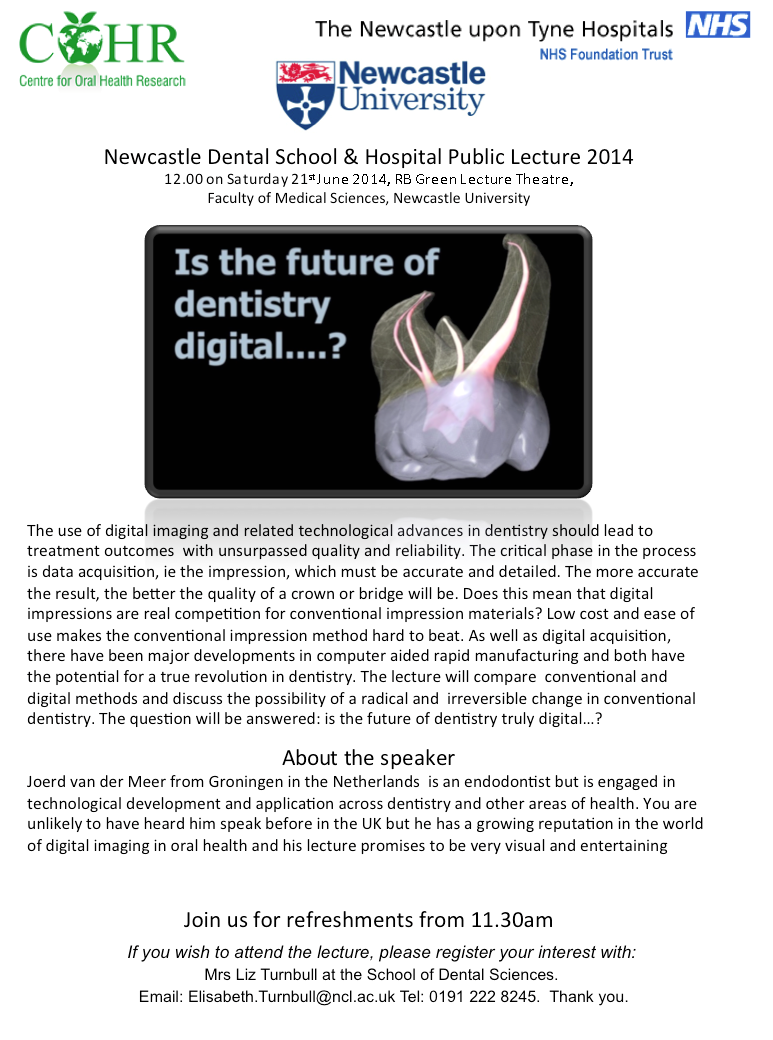
Newcastle Dental School & Hospital, Founders & Benefactors Lecture

This event used to be one of the highlights of the Newcastle Dental School year – I remember being thoroughly intimidated having to walk in procession in my plain black, short undergraduate gown with all the silks and ermines of the “high hiedyins” of the Dental School.

In the past it was called the Founders & Benefactors Lecture and coincided with the “homecoming” weekend for dental graduates which also featured the Dental Graduates Ball. Times have changed, the ball no longer happens and the weekend has moved from March to June to be included in the general reunion weekend for all Alumni of The University of Newcastle-upon-Tyne. I see that it’s now the “Public Lecture” 2014.

Last year Martin Kelleher was the speaker, this year it’s Joerd van der Meer and his subject is digital imaging – looks like a really good event.

Screen Shot 2014-02-16 at 13.09.35

The Monday Morning Quote #255

“Continuous effort – not strength or intelligence – is the key to unlocking our potential.”

– Winston Churchill

“Artists don’t show you their brushes do they?”

An interesting conversation with someone non-dental, but with forcefully held opinions, about dentists’ websites. It only re-enforced my views that the only people interested in technical dentistry are dentists and dental people.

Went along the lines of , “Alun, you work with dentists and advise them on their business don’t you?”

I acknowledged that I did my best to do so.

“Then why the hell can’t you get them to stop putting horrendous pictures of bad teeth, surgical sites and blood on their websites?”

“I even saw one that had a pair of joke clacking teeth on it – are these people serious?”

“For heaven’s sake man don’t they realise that no-one wants to look at that stuff. If you buy a piece of art from an artist he doesn’t show you his brushes does he?”

I had no reply, apart from acknowledging his point of view was valid – can anyone help?

The Monday Morning Quote #254

“You can never cross the ocean unless you have the courage to lose sight of the shore.”

Christopher Columbus

220px-Christopher_Columbus

BDA warns that dental degree students face study-related debts up to £60,000

Press release from the BDA – judging from my anecdotal evidence £60K is a modest estimate. I know it’s the same in every other country in the world but what are the new graduates faced with on graduation? The nightmare of FD1 selection. Having to jump through NHS hoops thus reducing their abilities to earn sufficiently to start clawing back the mountain of debt.

When will we accept that the system is a mess? Successive governments for the sake of political dogma have messed things about. This is yet another facet of broken health and education systems that have evolved without thought or consideration for the young people who are being crushed within them, as long as some party spokesperson can stand up in the run in to the next election and peddle the lie that “the NHS is safe in our hands”.

Starts here:

PR06.14  19 February 2014

BDA warns that dental degree students face study-related debts up to £60,000

Dental students who started their degree in 2013-14 face the prospect of staggering levels of debt, in the region of £60,000, a new study suggests.

The research into study-related debt carried out by the British Dental Association (BDA) also found that students who sat their final-year exams in 2012-13 had an average debt of £24,734 at the end of their studies. Around half of all these said they had experienced financial difficulties during their degrees, which some linked to a shortfall in mainstream funding available to them in their final year.

In addition to £9,000 a-year tuition fees, students finishing their degree in 2018-19 could face a shortfall of at least £38,000 in maintenance funding over their five-year course.

Chair of the BDA’s Student Committee, Dr Paul Blaylock, said:

“Student debt is a growing concern in dentistry, which is likely to get worse with the introduction of £9,000 tuition fees.

“Those who struggle to make ends meet also have to put up with inadequate maintenance loans.

“The BDA believes that maintenance loans could be increased to ease the financial pressures for dental students.

“It’s important that those who come from less affluent backgrounds are not deterred from taking up dentistry – all of the best, brightest and most caring candidates should be able to join the profession.”

Further details of the study can be found on the BDA website.

Ends

Notes to editors

The British Dental Association (BDA) is the professional association for dentists in the UK. It represents dentists working in general practice, in community and hospital settings, in academia and research, and in the armed forces, and includes dental students.

For further information, please contact the BDA’s media team on 0207 563 4145/46 or visit http://www.bda.org/news-centre/. You can also follow news from the BDA on Twitter: http://twitter.com/theBDA.

Exchange it …Roy Lilley’s blog on the NHS Management

I spend most of my working life helping dentists, medics and other small business owners with their businesses. I firmly believe that you must have basic understanding of the way your business is supposed to run profitably else you will get into trouble.

The repeated parachuting of celebrity business leaders into government organisations doesn’t seem to me to be anything other than a gimmick. Roy Lilley makes the case far better than I can. Today’s piece sees him reflecting on the appointment of Sir Stuart Rose to help with “failing hospitals”. Sir Stuart who recently took over as chairman of Oasis Healthcare dental group has, to quote the Financial Times, a “bulging portfolio” of jobs. In addition to Oasis he chairs Fat Face, Blue Inc and Ocado; he is also a non-executive director of Land Securities and the South African firm Woolworth Holdings.

The NHS doesn’t need big name business leaders, it needs fewer politicians.

Roy’s piece starts here:

The latest celebrity wheeze is to invite Stuart Rose, former boss of M&S to sort out the NHS’s 14 ‘failing Trusts’.

I could be very picky.  I could tell you my recent experience of trying to buy a size 16 ½, wide-cut collar, slim fit, double cuff, white shirt at M&S.  I won’t… It would take my entire 700 words, shock M&S management and explain to the City why their non-food results aren’t going so well.

I could be even more of a smarty and ask what happened to Gerry Robinson?  Didn’t he ‘Fix the NHS’?  Philip Green was going to show how clever he was at buying knickers and revolutionise NHS procurement.  Err, who remembers Loyd Grossman, Albert Roux, Heston Thingamabob and James Martin ‘revolutionising’ hospital food.

Sir Stuart should be careful; the NHS employs 1.3m, most of whom are M&S customers!  What will he say?  Here’s my guess:

First, stop calling these 14 hospitals ‘failing’ Trusts.  They are not failing.  They are struggling, finding things difficult and in many cases, turning in heroic results against all odds.  At M&S we motivate people we don’t mow them down.  We help them, not hinder them with pejorative epithets that make enthusiasm and recruitment even more difficult.

Many of the 14 Trusts are located in tricky places making recruitment difficult, (too far from, or too near, major towns and glamorous teaching hospitals), they have a history of problems including a high turnover of management.  They are geographically isolated and lonely places to manage.  They have local health economies unable to support the level of service activity that is necessary for their communities.  At M&S we have to protect our shareholders and would close unprofitable branches.  The NHS has to protect the public and cannot close ‘unprofitable’ hospitals.  Get over it; invent a different finance regime for socially vital services and link them to other Trusts to broaden career opportunities, end their isolation.  If Monitor Off-Sick don’t like it – get rid of Off-Sick.

End the belief that everyone running a hospital has to be Steve Jobs, or Churchill or Gandhi or Mandela.  Being good and reliable administrators, dependable and honest is no bad thing.  What is required is to be seen and have a thorough familiarity and understanding of the ‘businesses’.  Working with clinicians to deliver fabulous outcomes is obvious.  At M&S our senior management work as a team and trust and value the expertise of our food and non-food expert colleagues.  Leaders emerge.  Give them time.  Cherish them.

At M&S we have a relentless focus on the customer.  It is not widely known that we count-in the number of people visiting a store and count the number of people who make purchases.  Our aim is to improve that ratio.  You can only do that by being one step ahead of what customers want and making it easy for them to get it.  We invest in the shop-floor-front-of-house and make it fun to work there.  Nurses are the NHS front-of-house.  Look after them.

At M&S we train and reward performance with industry benchmarked salaries, employee discounts, pensions, bonuses, Sharesave, perks on holidays and leisure attractions, flexible working and discounted healthcare insurance.  In the NHS you only have pay.  To get the best people you’re going to have to pay more.  That’s all there is to it.

Running a big M&S store is complicated but gets nowhere near the complexity of a hospital but some principles are the same.  A clear idea of what you want to achieve, tell everyone and get them all moving in the same direction… works just about everywhere.  The NHS is an undergrowth of targets, mixed messages, conflicting missions, values, strategies and tensions.

The last shop-keeper to have a go at sorting out the NHS was 1983, Sainsbury boss, Roy Griffiths.  He set up the structures that Lansley’s Reforms have just demolished and we forget he saw; “… a central role for doctors in management, both as chief executives and as the critical managers of resources within clinical directorates.”  We haven’t achieved it.  It will be interesting to see if Rose picks that up.  I don’t see too many butchers and shirt-makers on the Board at M&S

Most Celebrity Reports end up on the shelf but this time Rose can provide the shelf and if the Report doesn’t fit the bill, I guess we could take it back and exchange it?