A comprehensive guide to successfully marketing your dental practice by one of the UK’s foremost dental sales and marketing experts.
I’m surprised that I haven’t got around to featuring this excellent little book before now. David Holland has a successful history in sales and marketing with multinational companies but over the last decade has worked with many in the field of dentistry. He has certainly been responsible for shaking up my view of the business of dentistry. His experiences with a host of other businesses means that he is able to see dentistry without baggage.
If you’re a practice owner, an associate or practice manager then this will repay your time.
“David is a champion of innovation and marketing. His ideas and approaches should be studied if you want to stand out from the crowd…We have found his service to be exceptional! Highly recommended.” Barbara Naisby, Director, Black Isle Direct, Black Isle Dental Studio
“I attended several of David’s training courses on sales and I can say that he revolutionised my view and attitude to sales. He managed to educate me on a complex and big subject in ways that were instantly understood, and his effective and focused approach to his work shone through and was an inspiration to me.” Sandra Kanfer Clarke attended Sales Training with David in 2003
David’s introduction:
“As we all know, dentistry is not just a vocation – it is also a business. Like any commercial enterprise, it has products, services and customers. Naturally, there are a number different business models that exist within the field of UK dentistry. Some businesses choose to negotiate a co-funding relationship between the actual customer and the local Health Service or an insurance provider. Others enjoy a more direct relationship with their customers. This book aims to provide dentists, practice owners and practice managers responsible for growing the business profitably, with a series of targeted strategies and methods for building a more direct and productive relationship with their customers – one that benefits both the consumer and the dental practice itself. As I am a sales expert and not a dentist, it is very possible that I may have got some of the clinical details wrong. However, don’t let that put you off seeing the value of the ideas and strategies that I put forward in this book. Where appropriate, just insert the correct clinical detail and move on with adapting and implementing the proposed marketing plans within your particular clinical context.”
An agreed funding uplift for general dental practice across Scotland is to be implemented following a decision not to pursue a judicial review process that would have prevented the award being made.
Following careful consideration of the potential consequences of accepting the award uplift or pursuing a legal case, the BDA’s Scottish Dental Practice Committee (SDPC) has decided not to pursue a judicial review of Scottish Government’s decision to recover alleged overpayments of patient registration fees. It was made clear to SDPC by Scottish government that if such a challenge were made, the uplift agreed by SDPC in good faith earlier this year would not be honoured. This would have led to practices across Scotland being deprived of the funding indefinitely. It would also have caused significant pension detriment in the long term. Instead now, the uplift will be implemented from 1st November 2013 and backdated to 1 April.
A challenge could also have created further financial jeopardy, because in the event of an unsuccessful review the BDA would have been liable for both the Scottish Government’s costs and its own.
The BDA’s legal challenge to the proposal had already forced the Government to re-examine and delay implementation, allowing practitioners more time to understand the potential impact on their own practices and prepare for appeals where appropriate. It has also seen the timescale for the process extended and an appeals process for those who believe they are incorrectly being subjected to it established, following representations from SDPC.
Practitioners who are contacted about alleged overpayments should contact the BDA for advice.
“Latterly, we have also opposed Government proposals to recover monies already paid to practices as a result of the flawed system it insisted on introducing. This is a deeply unsatisfactory episode for which the profession is owed an apology.
“However, we have been presented with a very stark choice that has profound repercussions for dental care across Scotland and this is not a time to allow dogma to cloud our judgement. Practices and their patients come first and we are making the choice that best serves their interests by providing a much-needed and overdue injection of funding into NHS dentistry.”
Cliff Morgan has died at the age of 83. His career from Rhondda Valley to Broadcasting House and Television Centre has been fully documented elsewhere but I would like to remember the man who my father spoke about with respect and enthusiasm.
As a player he embodied everything that was great in a Welsh outside half; speed, anticipation, courage and above all the flair to do the unexpected and to bring the best out of everyone around him. Never better than when pulling the strings (and conducting the choir) on the Lions tour to South Africa in 1955 to let the talents of others like Tony O’Reilly, Jeff Butterfield and Arthur Smith shine. He played for Cardiff RFC (the club I followed as a boy) whilst studying at Cardiff University, the first of his family to go to university. He won a Grand Slam with Wales in 1952 and played in two teams (Cardiff and Wales) that beat the All Blacks in just over a fortnight in 1953 where his play was described, “…the memory of Cliff Morgan’s darting and swooping across the turf and skimming past every obstacle like a swift at play..” I consider myself lucky to have seen him play once. It was in a charity match at Cardiff Arms Park and must have been in the mid to late 60s nearly a decade after he had “hung his boots up”. What I remember was his reading of the game so that he could contribute the most whilst exerting himself the least.
As a broadcast executive his career says it all, from Sports Organiser with BBC in Cardiff, a spell at This Week with ITV, a producer of Grandstand and Sportsnight and eventually from 1976 to 1987 as head of outside broadcast for BBC TV.
He recovered from a stroke that might have killed lesser men when only 42 and (like my father) had a great relationship with Ireland (including an Irish wife).
On the screen he was one of the team captains on A Question of Sport and on radio my Saturday mornings have never been the same since he stopped presenting Sport on Four. That voice told stories beautifully, held you with its tone and timbre until the very last word. Sadly and with one of life’s dreadful ironies that since his treatment for cancer of the vocal cords he lost his ability to speak.
It was his voice as a commentator that has led him to be remembered most, when Bill McLaren was afflicted by ‘flu and had to withdraw from the coverage of the New Zealand v Barbarians match in 1973 Morgan stepped in. The try that started it, scored by a legend but the coverage was by a legend too. Rest in peace Cliff.
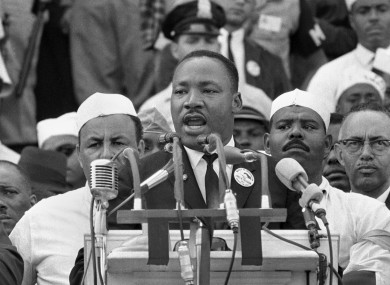
TODAY MARKS THE 50th anniversary of Martin Luther King’s most famous and rousing ‘I have a dream’ speech. (From thejournal.ie)
Masterfully orated to between 200,000 and 300,000 marchers, it is widely regarded as one of the greatest speeches of the 20th century.
At just 34 years of age, Luther King inspired generations of Americans to stand up and demand equality and full civil rights for the entire black population.
To mark the anniversary, here is that speech, in full:
“I am happy to join with you today in what will go down in history as the greatest demonstration for freedom in the history of our nation.
Five score years ago, a great American, in whose symbolic shadow we stand today, signed the Emancipation Proclamation. This momentous decree came as a great beacon light of hope to millions of Negro slaves who had been seared in the flames of withering injustice. It came as a joyous daybreak to end the long night of their captivity.
But one hundred years later, the Negro still is not free. One hundred years later, the life of the Negro is still sadly crippled by the manacles of segregation and the chains of discrimination.
One hundred years later, the Negro lives on a lonely island of poverty in the midst of a vast ocean of material prosperity. One hundred years later, the Negro is still languishing in the corners of American society and finds himself an exile in his own land. So we have come here today to dramatise a shameful condition.
In a sense we have come to our nation’s capital to cash a cheque.
When the architects of our republic wrote the magnificent words of the Constitution and the Declaration of Independence, they were signing a promissory note to which every American was to fall heir. This note was a promise that all men, yes, black men as well as white men, would be guaranteed the unalienable rights of life, liberty, and the pursuit of happiness.
It is obvious today that America has defaulted on this promissory note insofar as her citizens of colour are concerned.
Instead of honouring this sacred obligation, America has given the Negro people a bad cheque, a cheque which has come back marked “insufficient funds.” But we refuse to believe that the bank of justice is bankrupt.
We refuse to believe that there are insufficient funds in the great vaults of opportunity of this nation. So we have come to cash this cheque — a cheque that will give us upon demand the riches of freedom and the security of justice. We have also come to this hallowed spot to remind America of the fierce urgency of now. This is no time to engage in the luxury of cooling off or to take the tranquilising drug of gradualism.
Now is the time to make real the promises of democracy. Now is the time to rise from the dark and desolate valley of segregation to the sunlit path of racial justice. Now is the time to lift our nation from the quick sands of racial injustice to the solid rock of brotherhood. Now is the time to make justice a reality for all of God’s children.
It would be fatal for the nation to overlook the urgency of the moment. This sweltering summer of the Negro’s legitimate discontent will not pass until there is an invigorating autumn of freedom and equality.
Nineteen sixty-three is not an end, but a beginning.
Those who hope that the Negro needed to blow off steam and will now be content will have a rude awakening if the nation returns to business as usual. There will be neither rest nor tranquility in America until the Negro is granted his citizenship rights. The whirlwinds of revolt will continue to shake the foundations of our nation until the bright day of justice emerges.
But there is something that I must say to my people who stand on the warm threshold which leads into the palace of justice. In the process of gaining our rightful place we must not be guilty of wrongful deeds. Let us not seek to satisfy our thirst for freedom by drinking from the cup of bitterness and hatred.
We must forever conduct our struggle on the high plane of dignity and discipline. We must not allow our creative protest to degenerate into physical violence. Again and again we must rise to the majestic heights of meeting physical force with soul force.
The marvelous new militancy which has engulfed the Negro community must not lead us to a distrust of all white people, for many of our white brothers, as evidenced by their presence here today, have come to realise that their destiny is tied up with our destiny.
They have come to realise that their freedom is inextricably bound to our freedom. We cannot walk alone.”
“As we walk, we must make the pledge that we shall always march ahead. We cannot turn back. There are those who are asking the devotees of civil rights, “When will you be satisfied?”
We can never be satisfied as long as the Negro is the victim of the unspeakable horrors of police brutality.
We can never be satisfied, as long as our bodies, heavy with the fatigue of travel, cannot gain lodging in the motels of the highways and the hotels of the cities.
We cannot be satisfied as long as the Negro’s basic mobility is from a smaller ghetto to a larger one.
We can never be satisfied as long as our children are stripped of their selfhood and robbed of their dignity by signs stating “For Whites Only”.
We cannot be satisfied as long as a Negro in Mississippi cannot vote and a Negro in New York believes he has nothing for which to vote.
No, no, we are not satisfied, and we will not be satisfied until justice rolls down like waters and righteousness like a mighty stream.
I am not unmindful that some of you have come here out of great trials and tribulations. Some of you have come fresh from narrow jail cells.
Some of you have come from areas where your quest for freedom left you battered by the storms of persecution and staggered by the winds of police brutality.
You have been the veterans of creative suffering. Continue to work with the faith that unearned suffering is redemptive.
Go back to Mississippi, go back to Alabama, go back to South Carolina, go back to Georgia, go back to Louisiana, go back to the slums and ghettos of our northern cities, knowing that somehow this situation can and will be changed. Let us not wallow in the valley of despair.
I say to you today, my friends, so even though we face the difficulties of today and tomorrow, I still have a dream. It is a dream deeply rooted in the American dream.
I have a dream that one day this nation will rise up and live out the true meaning of its creed: “We hold these truths to be self-evident: that all men are created equal.”
I have a dream that one day on the red hills of Georgia the sons of former slaves and the sons of former slave owners will be able to sit down together at the table of brotherhood.
I have a dream that one day even the state of Mississippi, a state sweltering with the heat of injustice, sweltering with the heat of oppression, will be transformed into an oasis of freedom and justice.
I have a dream that my four little children will one day live in a nation where they will not be judged by the color of their skin but by the content of their character.
I have a dream today.
I have a dream that one day, down in Alabama, with its vicious racists, with its governor having his lips dripping with the words of interposition and nullification; one day right there in Alabama, little black boys and black girls will be able to join hands with little white boys and white girls as sisters and brothers.
I have a dream today.
I have a dream that one day every valley shall be exalted, every hill and mountain shall be made low, the rough places will be made plain, and the crooked places will be made straight, and the glory of the Lord shall be revealed, and all flesh shall see it together.
This is our hope. This is the faith that I go back to the South with. With this faith we will be able to hew out of the mountain of despair a stone of hope. With this faith we will be able to transform the jangling discords of our nation into a beautiful symphony of brotherhood. With this faith we will be able to work together, to pray together, to struggle together, to go to jail together, to stand up for freedom together, knowing that we will be free one day.
This will be the day when all of God’s children will be able to sing with a new meaning, “My country, ’tis of thee, sweet land of liberty, of thee I sing. Land where my fathers died, land of the pilgrim’s pride, from every mountainside, let freedom ring.”
And if America is to be a great nation this must become true. So let freedom ring from the prodigious hilltops of New Hampshire. Let freedom ring from the mighty mountains of New York. Let freedom ring from the heightening Alleghenies of Pennsylvania!
Let freedom ring from the snowcapped Rockies of Colorado!
Let freedom ring from the curvaceous slopes of California!
But not only that; let freedom ring from Stone Mountain of Georgia!
Let freedom ring from Lookout Mountain of Tennessee!
Let freedom ring from every hill and molehill of Mississippi. From every mountainside, let freedom ring.
And when this happens, when we allow freedom to ring, when we let it ring from every village and every hamlet, from every state and every city, we will be able to speed up that day when all of God’s children, black men and white men, Jews and Gentiles, Protestants and Catholics, will be able to join hands and sing in the words of the old Negro spiritual, “Free at last! free at last! thank God Almighty, we are free at last!”
1. Never open a book with weather.
2. Avoid prologues.
3. Never use a verb other than “said” to carry dialogue.
4. Never use an adverb to modify the verb “said”…he admonished gravely.
5. Keep your exclamation points under control. You are allowed no more than two or three per 100,000 words of prose.
6. Never use the words “suddenly” or “all hell broke loose.”
7. Use regional dialect, patois, sparingly.
8. Avoid detailed descriptions of characters.
9. Don’t go into great detail describing places and things.
10. Try to leave out the part that readers tend to skip.
“My most important rule is the one that sums up all ten
Department of Health plans to remove the restriction on HIV-positive dentists practising in England from April 2014 have been welcomed by the British Dental Association (BDA). The move, which was announced today (15 August 2013), has been called for by the BDA and others for many years.
It is a victory for common sense, the BDA believes, because it reflects the fact that, globally, over the past 20 years no dental professional has been linked with the transmission of HIV infection to a patient, and huge advances in anti-retroviral treatment mean that the virus can be suppressed to the point where it is undetectable in a blood test.
The BDA has long called for an end to the policy whereby HIV-infected dentists who are otherwise well and on effective anti-retroviral treatment are forced to give up their chosen career. Further, patient safety in dental settings has been enhanced over the past two decades by the adoption of universal precautions and a legal duty to comply with rigorous infection control procedures.
The Department of Health’s change in policy is based on an expert assessment by a Tripartite Working Group of the accumulated evidence from around the world on the negligible risk of transmitting HIV from an infected healthcare worker to a patient.
Today’s announcement indicates that HIV-positive healthcare workers who return to clinical duties will be required to demonstrate that they are on combined anti-retroviral treatment, must have achieved undetectable levels of the virus and will be subject to regular monitoring.
The BDA’s scientific adviser, Professor Damien Walmsley, said:
“Under the current regulations, being HIV-positive effectively brings a dentist’s career to an end. That is a tragedy for the individual practitioner and an unnecessary waste of the taxpayers’ money invested in their training. Despite extensive investigation, no case of HIV transmission from a healthcare worker to a patient has ever been identified in the UK.
“That is unsurprising. Dentists in the UK comply with rigorous infection control procedures to protect both patients and the dental team against the risk of transmission of blood-borne infections.
“The revised policy announced today, which brings England into line with nations including Sweden, France, Canada and New Zealand, is good news for patients and HIV-positive dentists alike. We look forward to seeing its implementation.”
Ends
Notes to editors:
1. Universal precautions means that the same infection control procedures are used for all patients because a medical history and examination may not identify asymptomatic carriers of infectious disease. This approach protects patients and healthcare workers alike from any potential transmission of a blood borne virus.
2. A review by the Tripartite Working Group in 2011 into the management of HIV positive healthcare workers in 2011 observed that nearly 10,000 patients in the UK have been tested for HIV following an exposure prone procedure performed by an HIV-infected HCW and no cases of transmission were identified.. This report recommends that restrictions on HIV-infected HCWs be relaxed if certain conditions are met and underpins the Department of Health’s announcement today.
3. The BDA responded to consultations on this issue launched by Governments across the UK in 2011.
4. David Croser of Dental Protection was honoured by the BDA in 2012 for his campaigning work on this issue.
5. The British Dental Association (BDA) is the professional association for dentists in the UK. It represents dentists working in general practice, in community and hospital settings, in academia and research, and in the armed forces, and includes dental students.




 The Incisal Edge