“A pessimist sees the difficulty in every opportunity; an optimist sees the opportunity in every difficulty.”
Winston Churchill
The blog of Alun Rees, The Dental Business Coach
“A pessimist sees the difficulty in every opportunity; an optimist sees the opportunity in every difficulty.”
Winston Churchill
This was posted by Laurence Lando on GDPUK
“Just back from NYC having attended another spectacular GNYDM. Many live patient demonstrations, that made new techniques so much easier to comprehend.
Meeting our colleagues from the USA is just sooo illuminating. The economy is so bad, that patients just want their dentist to carry out ‘dentistry’. Botox and whitening have taken a huge hit, and many are going to rename their ‘spas’, ‘dental practices’.
Current cost of a molar endo is $1800! Crown extra of course. Not as many Brits this year, but tons of the Irish!
If you haven’t been to this mega dental event, look up the website and consider a few days away from the ‘dental practice’.”
My take is that “The Facial Aesthetics Thing” was seen as many within the profession as a solution for all and any problems, that they wouldn’t have to learn how to do nuts & bolts dentistry just do the pretty things. I think that there is definitely a place for Facial Aesthetics within the mainstream but it has to be a part of, but not separate from, the tooth business.
The way to do it is like Harry Singh & his team have at Aesthetics in Hatfield.
 It’s almost one week into December so now is the time to get your thoughts aimed towards 2009 (or even 2010). This will help you ask yourself the difficult questions that you know you ought to ask but somehow manage to avoid.
As with any book on self improvement I.A.D.O.Y. – It All Depends On You. If you are in need of assistance & I can’t persuade you to hire a coach then give this little book a lash.
Buy it through Amazon here.
From Will Kintish’s blog here’s an article by Ivan Misner.
“It’s Called Networking for a Reason”
It’s not “net-SIT” or “net-EAT”-it’s “network.” Successful networking is about learning how to “work” the networking process-not just letting it happen.
In many ways, success at networking is the perfect example of the uncommon application of common knowledge. Most people understand that networking is important to their success-they just lack a step-by-step process to get the results they want. Almost no one really incorporates a comprehensive methodology that will build a business through networking. Thus, the need to network is “common knowledge,” and the development of the methodology required to be successful at it is the “uncommon application.”
The word networking has become so overused that some business professionals can no longer define it. Many people think that networking is attending social or business after-hour events, shaking a few hands, collecting a few cards, and, of course, giving away a few cards of their own. Sadly, they actually believe that’s all there is to networking. To be fair, we could say they’re engaging in social networking. That’s never to be confused, however, with business networking.
I’ve found that businesspeople tend to fall into one of two groups when it comes to their views of networking. For many, the current mind-set is that networking is a passive business strategy, not a proactive marketing tool. This attitude results in a scattered, often ineffective networking approach that consequently wastes the business owner’s time and money. Not surprisingly, when people feel they’ve been wasting their time and money on something, they’re understandably not going to continue that activity.
On the other hand, some entrepreneurs do consider networking a proactive marketing tool for their business. How can you tell? They make it a significant part of their marketing and business plans. They have networking goals. They may even have a budget line item for networking. Most important, they practice it and live it every day.
If you share the first mind-set-the passive one-you’re hoping that just showing up at meetings is enough. And therein lies the problem. You need to integrate networking into the way you do business on a weekly basis. This approach truly brings networking into your business as a proactive marketing tool. For examples of straightforward ways to do this, pick up a book that I co-authored with Michelle R. Donovan entitled The 29% Solution. In it, you will find 52 weekly strategies to quickly incorporate networking into your life.
Building these strategies into your life helps you maintain your focus on networking while you work to identify new revenue streams for your business. Before you know it, you’ll be driven by the intention to get new business, and you’ll have the networking tools to satisfy that drive, because-let’s face it-if you have no new business, soon you will have no business at all.
About the Author:
Called the “Father of Modern Networking” by CNN, Dr. Ivan Misner is a New York Times bestselling author. He is the Founder and Chairman of BNI (www.bni.com), the world’s largest business networking organization. His latest book, The 29% Solution can be viewed at The 29% Solution. Dr. Misner is also the Senior Partner for the Referral Institute, an international referral training company (www.referralinstitute.com).
He can be reached at misner@bni.com.
John Naughton is one of my favourite writers in whatever format I read his work. This is from his recent blog and I think he has created a new word – cyberchondria.
“It is better to burn out than is to to rust.” Neil Young
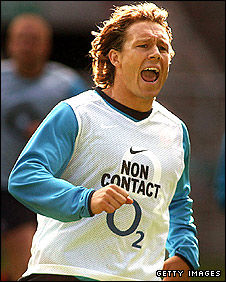

 New sponsorship deal for our Johnny.
England rugby World Cup hero Johnny Wilkinson has today signed a new record breaking two year contract with the BUPA North East Sports Hospital in Newcastle.
The deal which is estimated to be worth £350,00 a year will see the drop-kick king spend a further two years at the exclusive private sports clinic.
Said BUPA North East Sports Hospital Chief Executive Rob Andrew:
“I am delighted to be able to sign up Johnny for a further two years. He’s quite clearly the best patient in English Rugby. He rarely troubles himself with playing sport, and when does occasionally leave the hospital he soon returns. I guess he must like the place.”
Publicity-shy Johnny, best known for appearing in TV adverts for The Times, Boots and Lucozade, said:
“I have spent the best part of my career on the treatment table here at the BUPA North East Sports hospital. I’m delighted to sign up for a further two years.”
Johnny recently made his BUPA North East Sports Hospital comeback after a brief period on the sidelines playing rugby with Newcastle Falcons. He is now safely tucked up in bed monitoring his own progress in the broadsheet newspapers.
“We have told him before that he should never play rugby,” Rob Andrew said.
“It only leads to heartache. If he stayed in hospital like he supposed to, the papers could get on with their job of printing nonsense stories about his never-ending recovery from injury.”
 Topical enough, as the Autumn International Rugby circus reaches its conclusion with Wales the only team to beat southern hemisphere opposition.
So perhaps it’s a good time to take another look at this book from the man who facilitated what is arguable England’s greatest sporting triumph since 1966. As a Welshman (albeit with an Irish passport) I had little to cheer about in recent years whilst following the national sport. Living in rugby mad Gloucestershire I watched the English triumph in Sydney in 2003 with my teeth (complete with their new fixed appliances) gritted and have endured the patronising comments ever since.
However I am enough of a fan to appreciate how good that collection of players was and to admire the way that they were prepared and conditioned, not only for that campaign, but for the several years leading to Australia using concepts taken from the world of business. It is for that reason that I suggest you read this as there are lessons for every business owner.
Sir Clive’s book is a very readable account from his appointment to the top job in 1997, including a lesson in how not to do an induction, “Office? Secretary? What do you need a secretary for Clive? You’re a coach; your place is out on the pitch with players. He shares with us the highs and lows of the way to the winning of the Webb Ellis trophy, including falling at the final hurdle in several Grand Slam attempts and the disappointment at being beaten by South Africa (with drop goals) in the quarter final in Paris in 1999.
I think what makes Woodward different from a lot of other coaches in sport is his willingness to do whatever is necessary, however unorthodox, to improve the team’s performance. Never afraid to change the organisation of his ‘back-room’ staff or to bring in assistance from outside what would be considered the normal sporting establishment he gave his players every last piece of assistance in order for them to perform on the field.
Certainly England had underperformed at rugby for generations, they have the largest playing base of any country in the world several times greater than New Zealand and Australia (where Rugby Union is the third or fourth most popular sport behind Aussie Rules and Rugby League). England also had the financial clout to prepare teams, but the decision makers were amateur ‘the 57 old farts in blazers’ as Will Carling once famously said. Woodward wasn’t afraid to challenge this committee bound top echelon and ultimately it provided his undoing, realising that in order to take English Rugby forward needed more commitment from the RFU and constant improvement then when that was refused he was left with little choice but to walk away.
My copy of the book ends with him preparing to take the British Lions on tour to New Zealand, a tour that was disastrous both on and off the pitch; the Test matches were lost, the captain was injured in the opening minutes of the first test, several players returned home and missed large amounts of time because of injuries picked up on the trip. Many other players were either taken when clearly unfit or were selected because they had been part of a World Cup winning squad rather than a more recent Grand Slam winning one.
During ‘Winning’ Clive is clear to point out that it is important to take the long view and that it takes time to prepare, so perhaps he wasn’t the right man to lead a squad from four countries and to mould them in such a short space of time. Having been an insistent critic of Graham Henry who coached the previous Lions tour to Australia and narrowly lost the series, I am sure Sir Clive learned many lessons during his short trip to the Land of the Long White Cloud, not least of which is how hard the job is when you are THE man.
England have struggled since Sir Clive moved on, it seems perhaps that the one thing he didn’t do, in Covey terms, was to leave a legacy. Available from my Amazon store: here.
From Seth Godin’s blog, this says a lot about the times in which we live.
I had lunch (a big lunch) with a college student last week. An hour later, she got up and announced she was going to get a snack. Apparently, she was hungry. Read more.


 The Incisal Edge