Are Staff Happy?

Received this recently and thought I’d share it because I believe it is relevant to the owners of all professional practices.

What are you doing to make sure that your team works together and stays together?

Editorial – Are Staff Happy?
By Steve Gold, Editor, Management in Brief

www.managementbooks.co.uk

I’ve just got back from not one, but two business shows this week in, respectively, London and Birmingham, and the one thing that struck me was that – behind the smiles to customers – staff were not happy.

When I say unhappy, I mean unhappy with their lot in life as regards business, and judging from the off-guard comments, it all comes down to the managers at the companies they are working for.

Poor management? Quite possibly, so I was interested to see a news story from P&MM Motivation in which John Sylvester, the firm’s executive director, said that keeping employees motivated throughout the recession is “a marathon and not a sprint.”

According to Sylvester, the announcement that the UK `officially’ came out of its recession at the beginning of 2010 may have offered some encouragement of a positive outlook for the year ahead.

However, he says, nobody is really left in any doubt that the end is, in fact, nowhere near to nigh as the UK’s economy remains in its turbulent predicament.

“To see this dim light at the end of the tunnel only for it to be quickly extinguished again, as the patience and resilience of organisations and their employees is tested further, really brings home the truth that maintaining morale through this difficult era must be considered as a marathon and not a sprint,” he said.

Sylvester argues that motivation must remain high on the business agenda throughout 2010 in order to break through the brick wall that marathon runners meet in the final stages of their race.

Continual re-engagement, he says, is required in order to keep employees tuned into the changing company objectives so that they can head enthusiastically onto the next stage.

“Many job roles will have changed over the last year and feelings of job security may also be frail. Take the time to communicate with a workforce and inform them of what the organisation collectively requires in order to get back on top,” he explained.

The P&MM Motivation chief executive says that, on an individual level, managers should redefine each job proposition and set appropriate targets linked directly to the wider company goals.

They should, he observes, offer incentives for reaching these targets, as this approach to `sharing the fruits’ of success will be well received in an environment where pay freezes are the norm.

“All things going well, the need for further redundancies is less likely this year so employers are tasked with assuring staff of their job security,” he said.

The key to all of this, he says, is `recognition’ as this will help to ensure that employees feel valued and rewarded for the extra hard work, commitment and contributions that the current situation demands.

Sylvester claims that, if these efforts are not properly recognised, staff will quickly lose their enthusiasm and begin to set their sights on leaving once the recession has subsided.

In fact, he says, CIPD figures suggest that over a third of workers intend on seeking new employment as soon as the recession has subsided.

If managers can pre-empt this negative attitude by looking after valued staff now, they will weather the storm, as he quite rightly observes – the marathon is far from over.

I think he’s right too. As my experiences at the two business shows I’ve attended this last week clearly show, junior and mid-ranking staff in a large number of organisations are not happy with their employers.

We all have to pay the rent or mortgage, which is why most of choose to work as we do. When this recession ends, you can expect large-scale staff movements between companies.

As some companies will discover to their cost, when their most valuable staff start jumping ship.

Have a good business day.

STEVE GOLD
Editor

“Reducing Dental Errors Using Pilot Safety Protocol”

I have a client who is both a dentist and a pilot, on his recommendation  I read a book called “Air Accident Investigation” which examines (as you would gather) air accidents. My client has long been a fan of checklists in his practice in order to practice preventively, in this case to prevent mistakes. He’ll be pleased to see this article and I think a lot more surgeons and their teams could benefit from taking note of the principles.

www.medicalnewstoday.com/articles/196667.php

Pilots and dentists have more in common than one might think: Both jobs are highly technical and require teamwork. Both are subject to human error where small, individual mistakes may lead to catastrophe if not addressed early.

A dental professor at the University of Michigan and two pilot-dentists believe that implementing a checklist of safety procedures in dental offices similar to procedures used in airlines would drastically reduce human errors.

Crew Resource Management empowers team members to actively participate to enhance safety using forward thinking strategies, said Russell Taichman, U-M dentistry professor and director of the Scholars Program in Dental Leadership. Taichman co-authored the study, “Adaptation of airline crew resource management (CRM) principles to dentistry,” which will appear in the August issue of the Journal of the American Dental Association.

Airlines implemented CRM about 30 years ago after recognizing that most accidents resulted from human error, said co-author Harold Pinsky, a full-time airline pilot and practicing general dentist who did additional training at U-M dental school.

“Using checklists makes for a safer, more standardized routine of dental surgery in my practice,” said David Sarment, a third co-author on the paper. Sarment was on the U-M dental faculty full-time before leaving for private practice. He is also a pilot and was taught to fly by Pinsky.

CRM checklists in the dentist’s office represent a major culture shift that will be slow to catch on, but Pinsky thinks it’s inevitable.

“It’s about communication,” Pinsky said. “If I’m doing a restoration and my assistant sees saliva leaking, in the old days the assistant would think to themselves, ‘The doctor is king, he or she must know what’s going on.'” But if all team members have a CRM checklist, the assistant is empowered to tell the doctor if there is a problem. “Instead of the doctor saying, ‘Don’t ever embarrass me in front of a patient again,’ they’ll say, ‘Thanks for telling me.'”

At each of the five stages of the dental visit, the dental team is responsible for checking safety items off a codified list before proceeding. Pinsky said that while he expects each checklist to look different for each office, the important thing is to have the standards in place.

Studies show that CRM works. Six government studies of airlines using CRM suggest safety improvements as high as 46 percent. Another study involving six large corporate and military entities showed accidents decreased between 36-81 percent after implementing CRM. In surgical settings, use of checklists has reduced complications and deaths by 36 percent.

Many other industries: hospitals; emergency rooms; and nuclear plants look to the airline industry to help craft CRM programs, but dentistry hasn’t adopted CRM, said Pinsky.

For the next step, the co-authors hope to design a small clinical trial in the dental school to test CRM, Taichman said.

Source:
Laura Bailey
University of Michigan

www.medicalnewstoday.com/articles/196667.php

More brickbats than bouquets?

Yet again a new government in the UK sets its eyes on the NHS.

Why is it that change in the NHS has to be dramatic and so, so, expensive both in financial and human terms?

Is it really the case that having had to concentrate on the cold war for all those years politicians have to justify their existence on what they perceive to be the “biggest challenge” facing the country?

If the NHS is such a sacred cow why do successive health ministers insist on trying to apply such radical surgery with no scientific base?

In their dealings with health care why do politicians seem to have to let dogma dominate their policy far more than they do in any other sector?

Why do they listen so little to the individuals at the sharp end?

Why do they introduce changes that are untried and untested?

Why is there no science in their actions?

I would suggest that in Health (and the country’s involvement in Afghanistan, but that’s way beyond my area of expertise) they take note of George Santayana’s words:  “Those who cannot remember the past are condemned to repeat it.”

The BMJ recently asked a range of commentators from clinicians to academics to comment on the white paper on health Equity and excellence: liberating the NHS. Has the NHS become “a huge laboratory for some dodgy experiments,” in the words of one commentator; will the white paper divide the medical profession, as another claims; or will it simply empower doctors?

I’m grateful to my brother who is far more involved in both health & education than I for sending me this article and for pointing out what I agree is the best comment on the white paper. It’s by Jonathan Waxman, professor of oncology, Imperial College London who says:

The white paper is a finely written piece of prose redolent with allegory and metaphor that comes straight from a copywriter’s posterior. It proposes joined up, radical change to the way the NHS is managed and will empower the professionals . . . well some of them, the GPs. The trouble is that the white paper doesn’t seem to be written by an empowered joined up professional, and so lacks insight into the way the NHS works. It shows little understanding that health care is complex and doesn’t just involve one group of doctors, but many professional groups working together.

It seems that the notional cost of introducing these proposed changes is £1.7bn (2bn; $2.6bn). We know that government costing estimates are born in ya ya land, and usually out by a factor of 10 or 100, or whatever. We have seen the £15bn disaster of the NHS computer costs. The primary care trusts were introduced without trialling, and they have been a mess that costs £5bn a year to administer. The NHS is a £100bn business. What type of business introduces change of the order that the government is proposing without trialling? Don’t you think we should think about things before we leap off the white cliffs into the savage sea and on to the razor rocks?

The current white paper sets one group of health providers against another. It claims to be joined up, but it is divisive and potentially destructive. Please minister, think again.

Those words again:

The white paper is a finely written piece of prose redolent with allegory and metaphor that comes straight from a copywriter’s posterior.

……lacks insight into the way the NHS works. It shows little understanding that health care is complex and doesn’t just involve one group of doctors, but many professional groups working together.

Please minister, think again.

I couldn’t agree more.

The Monday Morning Quote

You cannot stay on the summit forever; you have to come down again. So why bother in the first place?

Just this: What is above knows what is below, but what is below does not know what is above. One climbs, one sees. One descends, one sees no longer, but one has seen.

There is an art of conducting oneself in the lower regions by the memory of what one saw higher up.

When one can no longer see, one can at least still know.

Rene Daumal

Thanks to Tony Barton of Red Kite World for introducing me to this quotation & the works of Rene Daumal.


The Weekend Read – The Buddha, Geoff and Me by Edward Canfor-Dumas

Sometime during the days following October 10th 1957 my father delivered my 4 year old self, wrapped in pyjamas and dressing gown, to The Laurels, Huntley. We made the journey because my brother had just been born, a home delivery, and I presume my Mum, whose 86th birthday it would have been today, needed some space.

The Laurels in those days was the home of Bill and Nan Lane and their family, they had 5 children, the youngest of whom Christopher was at least 10 years older than me. The next up was Rachael at that time in the sixth form at Gloucester High School for girls in Denmark Road.

It was during this visit that Rachael taught me to read, I can still remember the patient way she helped me distinguish the shapes and forms of the words and how they made sense. I have never looked back.

I was frequently “left” with the Lane family, who had been a part of my parent’s “courting” days, I loved being there, in what seemed to me to be a huge house in the country. Later on I remember sitting outside the house at the side of the A40 selling plums for  a week or more reading my way through Enid Blyton’s Famous Five novels, I must have been 8 or 9 – what would the Daily Mail say now? (Child left at roadside to peddle fruit, at risk from every passing pervert!).

Books again, so having “got it” my home was a treasure trove, my father worked for William Collins the publishers and so was forever coming home with all sorts of books, I couldn’t tell what was “adult or child” so if it was on the shelf I helped myself and got on with it or didn’t.

I have bought, skimmed, scanned, read or just ignored most of the popular, self-improvement books. It’s my nature, it’s part of being a coach to know what tools to suggest for my clients to use. So when I read in an ezine (ironically I can’t remember whose) someone suggesting this book as a good read I gave it a go.

The story is straightforward, Ed has just split up from his girlfriend, he hates the job he’s doing and his life is generally going nowhere. He bumps into Geoff in the pub one lunchtime, falls into conversation with him, helps him unblock a drain and listens to little of his philosophy. This first meeting leads to many more and follows Ed’s exposure to the form of Buddhism followed by Geoff, through Ed’s devout scepticism of all forms of religion to a gradual acceptance of the teachings of Nichiren Daishonin.

What’s unusual about this book is the effect it had on me, I read it in three sittings and, on completion,  started it again and am more than half way through my second read.

I have problems explaining why it’s so good, it’s well written without a doubt, the author is a highly skilled and experienced writer for TV, both drama and comedy, and advertising. Perhaps the message was right for me right now as I felt it’s a book I had been waiting to read.

Whatever, I urge you to read this book, enjoy the experience and let it weave its spell on you.

It’s available from my Amazon store here.

Choosing your customers – Seth’s Blog

He’s right (again) but not enough have ears to listen, here’s the link.

Yes, you get to choose them, not the other way around. You choose them with your pricing, your content, your promotion, your outreach and your product line.

When choosing, consider:

How much does this type of customer need you

How difficult is this sort of person to find…

and how difficult to reach

How valuable is a customer like this one…

and how demanding?

It’s not a matter of who can benefit from what you sell. It’s about choosing the customers you’d like to have.

A Dentist’s View of Baghdad or You think dealing with a PCT is “challenging”?

I had archived this link and forgotten about it, I think it gives some perspective on HTM01-05, PDS plus and the vagaries of government policies here in the UK. It comes from January 2009 and was first published in Iraq Tomorrow.

A Dentist’s View of Baghdad

Two recent stories from an Iraqi blogger provide an interesting snapshot of Baghdad as the city catches its breath.  He is a dentist who has a hard time practicing his profession because his clinic has no electricity.  Electricity is still minimal in most of Baghdad, and this is normal.  It is also normal for there to be endless traffic jams interrupted by checkpoints, manned by Iraqi soldiers who are often overwhelmed, as reported in this story from another Baghdad dentist.

Even with all of this, Dr. Mohammed runs into a different kind of inconvenience that he had not expected.  He goes for a bite to eat, only to find the corner store next to his clinic closed for renovations, paid for by the US Army.  In the big picture, the store is part of an on-going effort by the US military to rebuild Iraq, or at least lend a hand.  The overall impact of these projects is questionable, though there have been some prominent successes, such as the US-funded rebirth of Abu Nuwas street.  In Dr. Mohammed’s view, in a city where progress is often hard to see even a small step forward is a good thing.  The rebuilding projects create jobs, improve the neighborhood’s appearance, and indirectly reduce the chances of violence.

But as the local pharmacist describes the project to Dr. Mohammed, he becomes angry.  In his view, the Americans are paying for it with Iraq’s oil money, which they stole.   For him, nothing can overcome this perceived injustice, not even the fact that the supposedly stolen money is being re-invested where it can help Iraqi people.  Dr. Mohammed disagrees, but does not challenge the pharmacist’s main perception-that the US is stealing Iraqi oil.

The pharmacist’s information is wrong, of course.  Though there has been much talk of using Iraq’s oil revenues to fund reconstruction, the effort has been funded almost entirely by the US taxpayer so far.  In the meantime, the only oil production contract Iraq has signed since 2003 is with a Chinese company.  Overall there is very little evidence that the US as a whole has profited financially from its involvement in Iraq.  The perception, however, is difficult to defeat.  From an Iraqi perspective, for the US to occupy their country and not profit simply does not make sense.  They cannot see the powerful internal political forces which have mostly driven US decisions.  Perceptions like these make it hard for some Iraqis to accept successful US aid projects for what they are-help in a time of need.
In another entry the dentist shares some of his experiences as a patient, and his assessment that all is not well with the Iraqi health services.  Many clinics lack the basic equipment they need to help patients, and an almost impossible beauracracy prevents them from getting what they need.  More serious than these material shortages is the lack of good doctors, many of whom have fled or been killed.  These factors have created a dangerous situation where even a dentist has great trouble finding proper care for his infected tooth and his pregnant wife.  Dr. Mohammed’s prognosis for ordinary citizens in this system is not good.
These stories and others like them, while only snapshots, show a scarred city with many wounds left to heal.

Twitter – I’m torn.

The title says it all really, I have two contrasting views on Twitter.

First up it’s fun and possibly useful, of that there is no doubt. Chris Brogan summed it up recently on the blog.

  • You can research things rapidly.
  • “Everything” is happening on Twitter first – so can you afford to be not in on things?
  • Friendsourcing
  • Micro-Attention-Sharing
  • Direct People to Good Causes (This I like very much)
  • Yep – you can keep in touch with people – “what are you doing?”

The downside is the sheer “noise” both literal and metaphorical. When I am working I usually have music playing quietly on iTunes or Spotify and the distraction of new messages arriving is a test of my tolerance – so I turn Tweetdeck (other applications are available) off and frequently forget to turn it back on again – so it’s obvious I don’t miss it. But, & it’s a big but, when I do have it turned on I’m drawn in.

I do tend to retweet others’ postings a lot, possibly because there’s a feeling of “I do wish I had said that”, and it’s my way of proving George Bernard Shaw correct when he responded to Oscar Wilde “You will, Oscar, you will.” Actually my reason for re-tweeting is the reason that I will carry mentions of most things events, courses, services on my blog and newsletter (even for other coaches with rarely a quid pro quo – if you’re reading, you know who you are); it’s to share information etc that I consider to be useful.

But it’s the sheer volume of posts that I can’t handle, I want to keep reading, “is there something that I might have missed?” It might be better if there were only the 140 symbols available, so that website addresses couldn’t be included. When a tweet carries a link to a website or a blog posting I can end up “losing” an hour or more as I follow down the leafy lanes of cyperspace losing myself in copses and thickets and jumping fences into new fields.

The other element I don’t grasp is why do so many people want to follow me? What does an executive in North Dakota find so blooming fascinating about what I might have to say? Does he really think he’s going to be able to sell me something? Apparently most people (unlike Stephen Fry & other twitteratti) follow about the same number who follow them, in my case it’s 291 to 326, which presumably means that a lot of the people who started by following me, & with whom I didn’t reciprocate, have dropped away – shame on you for such good sense.

Then there’s the people who just want to sell me something, anything, everything; over and over and over again. To them I apply the wonderful phrase that I learnt from Karen Skidmore “Vuvuzela Marketing”

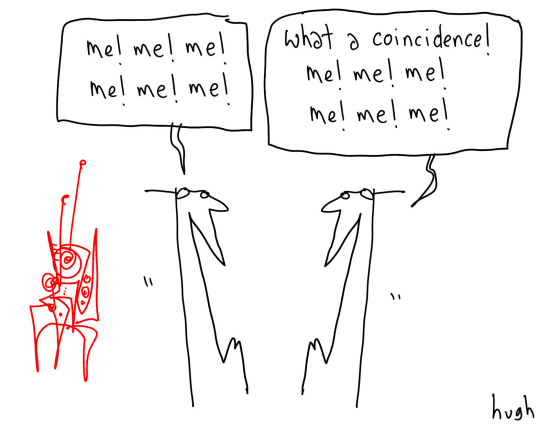
Finally it struck me earlier today what I really don’t like about Twitter, I was catching up on some blogs and I came across Hugh MacLeod’s “gaping void” cartoon from July 21st. Incidentally if you don’t follow Hugh then you really ought to, I don’t know if he tweets, but his cartoons are just brilliant. His website is here www.gapingvoidgallery.com.

What Twitter represents far too much to me is in this cartoon.

Kolbe Case Study – We Should Have Seen It Coming

Just published in the current edition of the Apex Online Journal – here

This is the story of a venture that failed, the business survived but the fallout and bad feeling between the participants persists. It wasn’t a dental practice, it could well have been and, bearing in mind the readership, I will retell the tale as if had been a clinical practice.

Mike and Neil are two practice owners, for several years they have been running their own successful “one-man bands” with varying amounts of staff support. Occasionally Neil provides holiday cover for Mike and has taken some referrals from him for the specific skills that he has developed. They each have support teams; Mike has a part-time but enthusiastic associate, Oliver and works with his partner, Philippa, who is a hygienist.

Fact Finder Follow Through Quick Start Implementor
Michael – Principal 5 5 7 3
Neil – Principal 4 5 8 4
Oliver – Associate 6 3 8 3
Philippa – Hygienist 7 3 6 3
Rosie – Recep/PM 7 8 3 2

After several months of discussion and enthusiasm they decide to go into partnership together. They will be expense-sharing partners, the business is launched and almost immediately there are operative problems.

Both partners are enthusiastic about using Kolbe in recruitment but make the fundamental error of failing to look at themselves as part of the bigger picture, in fact one of them says “this is bound to be a success we’re practically Kolbe twins.”

A brief explanation of some of the terms before we progress, Kolbe Wisdom is about how people will act and solve problems, the four Conative Characteristics are:

  • Fact Finder – Gathering and sharing of information.
  • Follow through – Sorting and Storing Information.
  • Quick Start – Dealing with risk and uncertainty.
  • Implementation – Handling space and intangibles.

Each Action Mode has three Zones of Operation, which determine how the individual acts when using it.

  • Initiating Zone: how they insist on beginning the problem-solving process.
  • Accommodation Zone: how they respond to people and situations.
  • Preventing Zone: how they avoid or resist problems.

Let’s look at that “Kolbe Twins” optimistic statement, which ironically is one of the keys to their failure. Both Michael & Neil Initiate in Quick Start, Respond in Follow Through & Fact Finder and as they have very similar scores for Implementor will tend to Prevent in that mode.

Through in to the mix the fact that Oliver also initiates in Quick Start and you have 3 individuals who will:

  • Take risks
  • Create a sense of urgency
  • Initiate change
  • Seek Challenges
  • Create Innovation
  • Act on Intuition

Now these characteristics are great for individual entrepreneurs but they need to be balanced by one or more people within the organisation who can Initiate in Follow Through & Implementor.

Rosie & Philippa who both score highly in Fact Finder both end up researching and researching until they come close to “Perfection Paralysis”, Rosie is the only person who initiates in Follow Through and she becomes overwhelmed.

The organisation lacks anyone who initiates in Implementor, there is no one who:

  • Has a Time Zone that is the Present
  • Is grounded in the here and now, who can create quality products that will endure through time.
  • Communicates using props, models & demonstrations.
  • Stores Information by Quality
  • Works with models or prototypes
  • Requires concrete, demonstrable goals that have lasting value.

So, the partners, who were always looking at the future, dominated business meetings with their MOs, the poor old practice manager (who had a financial stake in this particular business) desperately wanting to provide the information gets bogged down in detail.

The irony of this case is that what the leadership needed was someone who had the typical Kolbe score of a “hands on” dentist, who Initiated or Responded in Implementor and either Prevented or Responded in Quick Start, which would have brought the Team Synergy back to the appropriate levels. Unfortunately although those individuals might well have been available the partners’ “rush” was not balanced sufficiently from the outset and failure was inevitable.

The venture lasted as a going concern for fewer than nine months; the episode has left a bad taste in the mouths and soured the personal relationships of most of those involved. The two main protagonists have gone back to being – in the main – their own “bosses” but have learned to have great support teams.

The associate went on to give all his energies to his own practice that, contrary to his instincts, he had put on hold to do what he could for the new venture because he had wanted that to work. He proceeded to write articles like this one in an attempt to prevent the upset and confusion that can be caused when people ignore Kolbe Wisdom ™.

After several months of discussion and enthusiasm they decide to go into partnership together. They will be expense-sharing partners, the business is launched and almost immediately there are operative problems.

Both partners are enthusiastic about using Kolbe in recruitment but make the fundamental error of failing to look at themselves as part of the bigger picture, in fact one of them says “this is bound to be a success we’re practically Kolbe twins.”

A brief explanation of some of the terms before we progress, Kolbe Wisdom is about how people will act and solve problems, the four Conative Characteristics are:

  • Fact Finder – Gathering and sharing of information.
  • Follow through – Sorting and Storing Information.
  • Quick Start – Dealing with risk and uncertainty.
  • Implementation – Handling space and intangibles.

Each Action Mode has three Zones of Operation, which determine how the individual acts when using it.

  • Initiating Zone: how they insist on beginning the problem-solving process.
  • Accommodation Zone: how they respond to people and situations.
  • Preventing Zone: how they avoid or resist problems.

Let’s look at that “Kolbe Twins” optimistic statement, which ironically is one of the keys to their failure. Both Michael & Neil Initiate in Quick Start, Respond in Follow Through & Fact Finder and as they have very similar scores for Implementor will tend to Prevent in that mode.

Through in to the mix the fact that Oliver also initiates in Quick Start and you have 3 individuals who will:

  • Take risks
  • Create a sense of urgency
  • Initiate change
  • Seek Challenges
  • Create Innovation
  • Act on Intuition

Now these characteristics are great for individual entrepreneurs but they need to be balanced by one or more people within the organisation who can Initiate in Follow Through & Implementor.

Rosie & Philippa who both score highly in Fact Finder both end up researching and researching until they come close to “Perfection Paralysis”, Rosie is the only person who initiates in Follow Through and she becomes overwhelmed.

The organisation lacks anyone who initiates in Implementor, there is no one who:

  • Has a Time Zone that is the Present
  • Is grounded in the here and now, who can create quality products that will endure through time.
  • Communicates using props, models & demonstrations.
  • Stores Information by Quality
  • Works with models or prototypes
  • Requires concrete, demonstrable goals that have lasting value.

So, the partners, who were always looking at the future, dominated business meetings with their MOs, the poor old practice manager (who had a financial stake in this particular business) desperately wanting to provide the information gets bogged down in detail.

The irony of this case is that what the leadership needed was someone who had the typical Kolbe score of a “hands on” dentist, who Initiated or Responded in Implementor and either Prevented or Responded in Quick Start, which would have brought the Team Synergy back to the appropriate levels. Unfortunately although those individuals might well have been available the partners’ “rush” was not balanced sufficiently from the outset and failure was inevitable.

The venture lasted as a going concern for fewer than nine months; the episode has left a bad taste in the mouths and soured the personal relationships of most of those involved. The two main protagonists have gone back to being – in the main – their own “bosses” but have learned to have great support teams.

The associate went on to give all his energies to his own practice that, contrary to his instincts, he had put on hold to do what he could for the new venture because he had wanted that to work. He proceeded to write articles like this one in an attempt to prevent the upset and confusion that can be caused when people ignore Kolbe Wisdom ™.

The Monday Morning Quote

“What we think, or what we know, or what we believe is, in the end, of little consequence.

The only consequence is what we do.”

John Ruskin