Dentistry, Dermatology, what’s next?

I was the first born and studied Dentistry, my brother born 4 years later became a Dermatologist. I have wondered if there had been any more children they would have had to take up Endocrinology and ENT to keep the alphabetical order.

So I have had more than a passing interest in “Skins” and have listened to Jon’s stories of the attacks on this vital but overlooked area of medicine with disbelief. In this piece in Monday’s Guardian, “It took my patient six years to see me – a dermatologist”, the state of this particular piece of the NHS is spelled out. There is also a link to a “day-in-the-life” companion piece.

I am no great campaigner for the NHS, I think in many areas it is a spent, inappropriate, force. I feel that the repeated lies told over the past 36 years since Margaret Thatcher first coined the phrase “The NHS is safe in our hands” have only misled the population who would understandably prefer not to consider the alternative to the English religion.

Here’s the article:

It took my patient six years to see me – a dermatologist

Dermatology is a microcosm of the challenges facing the health service. It has reached crisis point

Why am I writing about dermatology? Surely the well-publicised crises in emergency medicine and general practice deserve these column inches. Dermatology is a small specialty where a slightly strange group of doctors choose to dedicate their careers to the treatment of rashes. Yet, dermatology is a microcosm of the challenges facing the NHS; like mental health and sexual health it is a specialty that has suffered progressively through NHS reforms and has now reached crisis point.

Imagine you have a rash or a growth on your skin and your GP does not know what it is or how to treat it. It may be scary – is it a skin cancer? It may be itchy, sore, bleeding, painful or looks awful. You are not alone, you are one of the 13 million people who consulted their GP last year about a skin problem and now you are one of the 750,000 referred on to see a dermatologist. These are big numbers, skin disease is common and the impact of skin disease is similar to epilepsy and chronic kidney disease.

It is clear that you need to see a consultant dermatologist, the one specialist who has the experience and expertise to help you. One quick trip to your local hospital and you will be sorted, or so the government would like you to think. In reality this is the start of battle. Firstly your referral will be triaged, another GP or nurse will read your referral and decide if you really need that appointment, many referrals are simply rejected at this point. If you pass through this then you are likely to be redirected to a privately run community dermatology service. These services, run by international healthcare corporations, employ nurse specialists and GPs with an “interest” in dermatology to see you for the cheapest possible price. In some cases they do little more than take a photograph and send this to a specialist for an opinion. It is only once you have gone through this process that you can, if you are lucky, join the waiting list to see a consultant dermatologist. In England you will wait four or five months, in Wales waits of two years are not uncommon.

A few weeks ago I saw a lady whose life had been ruined by constant episodes of swelling of her face leaving her looking like a victim of a serious assault. Her GP had correctly diagnosed angioedema but did not know the cause or how to treat it. It took her six years to navigate through triage centres and community clinics before seeing me. I quickly identified that her blood pressure medicines was causing the problem and by stopping this tablet her symptoms resolved overnight. She was extremely grateful, yet could not believe the journey she had suffered through to see me.

Government reforms have decimated dermatology leaving only 650 consultants covering the whole of the UK. Skin cancer is the commonest cancer in humans and the rates of skin cancer are increasing at a staggering 8% year on year. Dermatologists simply cannot cope with the volume of work and many smaller departments have closed, recently even the large university hospital department in Nottingham has all but shut its doors.

Across the country there are examples of departments restricting referrals or even closing to new referrals. The government promises choice, yet if you choose to see one of the nationally renowned skin cancer dermatologists at University hospitals Birmingham you better hope that you have a south Birmingham postcode as if you don’t then they will not see you. A pattern of referral restrictions being repeated across the country.

There is now a growing acceptance that in many parts of the UK it is all but impossible to see a consultant dermatologist in the NHS. With a government limiting NHS investment to headline grabbing acute specialities, how long before the rest of the NHS follows in dermatology’s footprints?

and also worth a read: The dermatologist: shipping us out of hospitals would be a grave mistake

The Monday Morning Quote #340 – Thomas Leonard October #3

“Focusing on the problem reinforces it.

Focus on the results; problems will take care of themselves.”

 Thomas Leonard

thomas-leonard

Dentaid helps (and seeks help) in Calais refugee camps

A team of volunteers is heading to the refugee camps in Calais tomorrow to provide emergency dentistry for people who have fled war and persecution.  Dentaid has provided a DentaidBox, equipment and advice to Kiran Ismail, a Manchester pharmacist who is leading a team of dentists and healthcare professionals in Calais. The team is setting up a dental clinic in the Jungle Camp which has become home to 4,000 people. Every day many people are arriving at the camps suffering from terrible dental pain and there is no-one to treat them.  But Dentaid is determined to help.

The team will be seeing patients in a caravan in the camp with a marquee acting as a waiting room.  They hope to establish a dental surgery on the site and that other dentists will also volunteer to help in the migrant crisis.

One of the charity’s trustees, Jonathan Gollings, has recently returned from France where he saw the desperate need for dental care in the camps. French law states that any dentist who works in the camps must be registered in the country and have permission to practice in Calais.

Dentaid is now appealing for any UK dentists who registered to practice in France, or French dentists, to volunteer their skills.

Please call us on 01794 324249 to find out more.

logo_f

Address: Giles Lane, Landford, Salisbury, Wiltshire, SP5 2BG
Website: www.dentaid.org
Email: info@dentaid.org

Bitter Pill for Sugar Tax

white_gold

Dr No has his doubts about the taxing of sugar and everything that is “bad” for us and also about the current government’s willingness to interfere with big business.

Tax it..is life really that simple?

Britain and sugar go back a long way, and the history is not that glorious. Sugar, or white gold as it was known, was reason for the infamous trade triangle, the round trip that took slaves from Africa to the American colonies, sugar from the colonial plantations to Britain, and goods from Britain back to Africa to buy more slaves. By the mid 18th Century, the trade was so lucrative that the then British Government, blissfully unaware of yet to come concepts of coercive healthism and the nanny state, did the fiscal thing, and slapped a tax on sugar, making it a luxury item. The situation was turned on its head in the mid 19th Century, when the Free Breakfast Table movement, an early Liberal free school meals idea aimed instead at the working classes as a whole, brought about the abolition of duties on sugar and other breakfast table commodities, and the masses were freed to shovel ever larger quantities of sugar down the cake hole. Every Little Helps, as they say at Tesco. Even today, The Great British Bake Off, when it isn’t about the BBC showing off its ethnic credentials, is all about devising yet more elaborate ways of getting yet more sugar through the cake hole.

Read the rest here

The Monday Morning Quote #339 – Thomas Leonard October #2

“Simplify Everything.

Abandoning the Non-Essentials leaves more room for you to Attract.”

Thomas Leonard

thomas-leonards-quotes-1

Black is the colour x2 – Rhiannon and Christy

I have been listening to Rhiannon Giddens’ solo album for months and couldn’t work out why this song was so familiar.

Then I remembered.

The Monday Morning Quote #338 – Thomas Leonard October #1

quote-all-problems-exist-in-the-absence-of-a-good-conversation-thomas-leonard-120-40-52

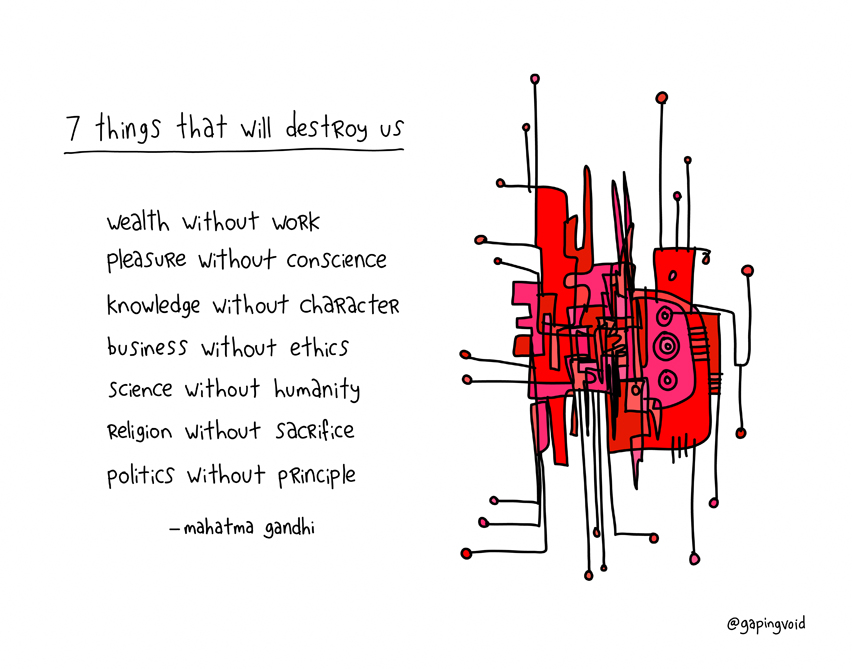
Today is Gandhi Jayanti – 7 Things That Will Destroy Us

Mohandas Karamchand Gandhi born October 2nd 1869.

His birthday is commemorated as Gandhi Jayanti, a national holiday, and world-wide as the International Day of Nonviolence.

62ce0913-b780-4ce6-b2d9-ed1c04fd7a35


Cartoon by Hugh MacLeod of Gaping Void

Can’t be complacent…

From the RBS Chief Economist’s Weekly Brief. Link.

The UK is enjoying its third-longest run of growth since the 1950s. 350,000 more people are in work today than a year ago. Unemployment is close to pre-recession levels. Real wages are rising. Corporate profits are as strong as at any time since the 1990s, at least outside of oil and gas. Business investment has been growing pretty consistently for more than five years. And all this without the slightest hint of inflation. We’ve rarely had it so good.

Reasons to be fearful? Yet if UK history is a decent guide to the future, we’re closer to the next recession than the last one. The greatest risks to the UK lie overseas. A still-fragile Eurozone economy relies on quantitative easing for the little growth it can muster. China’s slowdown is apparent in weak trade flows and lower commodity prices. These are already “priced in” to the view that UK growth will be a little slower in 2016. But recession – the one thing economists are notoriously bad at spotting – is unlikely.

Low. The average inflation reading in the UK this year has been a barely perceptible 0.1%. Lower oil and food prices are playing a role. And a gradual return back toward 2% is expected over the coming year. But other forces are keeping inflation low. The rise in sterling since the middle of 2013 has made imports cheaper. China’s slowdown is a disinflationary force for ‘made in China’ goods. And the forces of globalisation (heightened migration and offshoring boosting competition amongst workers and holding down wage growth) and technological change (similar mechanics) look here to stay. For interest rates to rise, there will have to be a compelling case of higher inflation ahead. For now there simply isn’t.

The pull. During the summer China snatched the ‘global economic risk baton’ from Greece and put the afterburners on. The country’s slowdown has intensified over the past 12 months, causing all sorts of issues for the global economy. At work is a post debt binge hangover and a need to ditch the country’s worn-out investment-led growth model. In the meantime China is pulling down on growth, trade, inflation and expectations for interest rate hikes, including the UK.

All and sundry. It’s not just China, emerging markets as a whole are having a difficult time with the reasons including a failure to raise productivity, a over-reliance on credit to fuel growth and, of course, the negative feedback loop of China’s slowdown. And there is the potential for financial distress should the Fed decide to raise interest rates. Navigating the route from emerging to developed economy has always been both difficult and rare. And so it continues to prove to be.

Tortoise. The eurozone remains characterised by modest growth, worryingly low inflation and an incomplete monetary union. To help with the first two the European Central Bank has floated the idea of further expanding its quantitative easing programme.  It would be better if the laggards – France and Italy – deepen reform efforts to prime their economies for growth. And the third? A report released by the EU’s institution leaders recently laid out a roadmap for ‘economic & monetary union’. Decades worth of political capital have been invested in the eurozone project. And much more will be invested to ’complete’ it. But that process, coupled with modest growth, leaves the eurozone vulnerable.

The weight. If you think the financial crisis was caused by too much debt best look away now. Since 2007 total debt in advanced economies has risen from 2.5x GDP to almost 3. Japan’s precarious 390% debt-to-GDP ratio is well known. But Belgium’s has risen by 85 percentage points since 2007 to nestle behind Japan at 342%. The Netherlands stands at 321%, and Sweden at 300%. China’s is up by 87 percentage points and France’s by 80. On this measure the US and UK look abstemious, as debt:GDP ratios have risen by 39 and 21ppts respectively. Low interest rates means servicing this debt is affordable. But what offers support can also imprison. How, with debt high and rising, can we afford higher interest rates?

Team Sky. The UK lags our peers in what we can achieve for each hour we work. GDP per hour is about 27% below that of the US, 25% behind France and 22% less than Germany. How do we close this gap? Firstly it’s about education. That’s education for all ages, but especially early years education, which equips children with the behavioural bedrock necessary for cognitive development. Second, we need more investment. We need more roads yes, but we also need to invest in energy, housing and broadband. Lastly innovation. That’s more than new products, encompassing better processes, ways of working and management. The best motivating factor is an old one – fear. Competition drives improvement.

The Monday Morning Quote #337

“The trouble with common sense is that it is so uncommon.”

Anna Freud

Anna-FEUD